
OPERATING SYSTEM
Operating System services and components
Operating System is a system software that manages all the resources of computing devices. Manages overall resources and operations of computer. Controls and monitors the execution of all other programs that reside in the computer, which also includes application programs and other system software of the computer.
This type of operating system does not interact with the computer directly. There is an operator which takes similar jobs having the same requirements and groups them into batches. It is the responsibility of the operator to sort jobs with similar needs. Batch Operating System is designed to manage and execute a large number of jobs efficiently by processing them in groups.
.webp)
⭕ Advantages of Batch Operating System
🔸In multiprogramming, more than one program lies in the memory.
🔸The scheduler selects the jobs to be placed in ready queue from a number of programs.
🔸The ready queue is placed in memory and the existence of more than one program in main memory is known as multiprogramming.
🔸Since there is only one processor, there multiple programs cannot be executed at a time.
🔸Instead the operating system executes part of one program, then the part of another and so on.
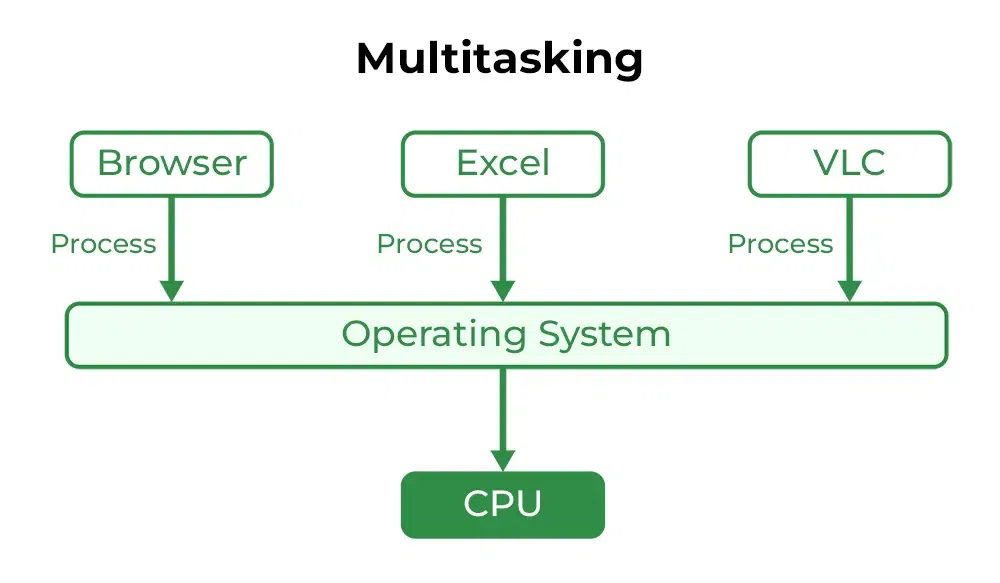
🔳 Example : User can open word, excel, access and other application in a system.

🔸It is a type of Multiprogramming system with every process running in round robin manner.
🔸Each task is given some time to execute so that all the tasks work smoothly.
🔸Each user gets the time of the CPU as they use a single system.
🔸These systems are also known as Multitasking Systems.
🔸The task can be from a single user or different users.
🔸The time that each task gets to execute is called quantum.
🔸After this time interval is over, the OS switches over to the next task.
⭕ Advantages of Time Shared OS
.jpeg)


0 Comments
Hi, Viewers Do not Enter Spam Messages in comments